
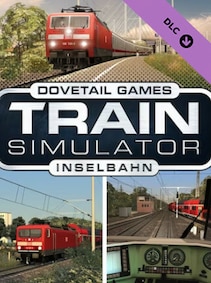
Train Simulator: Inselbahn: Stralsund – Sassnitz Route Add-On Steam DLC
- Genres
- Simuladores
- Release date
- April 18, 2019
- Developer
- Dovetail Games
- Publisher
- Dovetail Games - Trains
Price comparison



This site contains affiliate links. We may receive a commission at no additional cost to you.
Price history
It is below its usual price. It is not the all-time low, but it is a good offer.
- Recorded low€10.04 August 25, 2026
- Average price€12.16
- Recorded high€13.47
Once a day we record the lowest price that can be activated in Spain. Tracking starts when the game is added to the comparison site.
It is below its usual price. It is not the all-time low, but it is a good offer.
- Recorded low€10.04 August 25, 2026
- Average price€13.88
- Recorded high€24.38
We record the lowest available price regardless of activation region. Tracking starts when the game is added to the comparison site.
About Train Simulator: Inselbahn: Stralsund – Sassnitz Route Add-On
Description as published by the developer on Steam.
The 1860s, iron rails were rapidly spreading throughout Germany, including those of the Angermünde–Stralsund railway which was built to shorten journey times between the north of the country and Sweden. There was however an opportunity to get rails even closer to the Baltic border, the island of Rügen.
It would not be until 1883 when a railway on Rügen soil was built. It originally stretched as far as Bergen auf Rügen to begin with, and was extended 8 years later to reach the northern coast of the island at Sassnitz. At this point however, there was no fixed crossing with the mainland, instead, the body of water known as the Strelasund was traversed by ferry.
Traffic steadily grew in popularity as Germany and Sweden were ever closer linked. Mail would cross borders via Rügen faster than ever before, and eventually, a railway ferry was established between the two countries to bring them even closer together. The success of the ferry urged a greater connection to the mainland, and so in the 1930s a bridge was built over the Strelasund.
It wasn’t just Sassnitz and Sweden that benefitted from the island railway, the coastal town of Binz also found itself served by a single track branch line from Lietzow, and today serves as an equally important destination with every other train terminating there.
Following electrification, and the fall of the iron curt
System requirements
| Component | Minimum | Recommended |
|---|---|---|
| Sistema operativo | Necesita Windows 7 de 32-bits Service Pack 1, 8.1 o 10 (no se garantiza la compatibilidad de otras versiones o tipos de Sistema operativo) | Necesita Windows 7 de 32 o 64-bits Service Pack 1, 8.1 o 10 (no se garantiza la compatibilidad de otras versiones o tipos de Sistema operativo) |
| Procesador | Intel Core-i3 4330 3,50 GHz Dual Core, AMD A8 6600K 3,90 GHz Quad Core o versiones superiores. | Intel Core-i5 4690 3,50 GHz Quad Core, AMD Ryzen 7 1700 3,80 GHz Quad Core o versiones superiores. |
| Memoria | 4 GB de RAM | 4 GB de RAM (máximo posible con Windows de 32-bits)/16 GB o superior (para Windows de 64-bits) |
| Tarjeta gráfica | NVIDIA GeForce GTX 750 Ti, AMD Radeon R9 Graphics con 1 GB de VRAM dedicada o versiones superiores. | NVIDIA GeForce GTX 970 o AMD Radeon RX 480 con 4 GB de VRAM dedicada o versiones superiores |
| DirectX® | 9.0c | Same as minimum |
| Red | Conexión de banda ancha (puede generar gastos adicionales por uso) | Same as minimum |
| Almacenamiento | 40 GB o más de espacio disponible (cualquier adición requerirá más espacio) | Se recomienda usar un SSD de alto rendimiento con 40 GB o más de espacio disponible (cualquier adición requerirá más espacio) |
| Tarjeta de sonido | Dispositivo de audio compatible con DirectX | Same as minimum |
Notas adicionales: Necesita ratón y teclado, o bien mando de Xbox
Requirements published by the developer on Steam. Actual performance depends on resolution and graphics settings.
Related to Train Simulator: Inselbahn: Stralsund – Sassnitz Route Add-On
 Steam
Steam
Train Simulator: West Somerset Railway Route Add-On
 Steam
Steam
Train Simulator: Pacific Surfliner® LA - San Diego Route
 Steam
Steam
Train Simulator: East Coast Main Line London-Peterborough Route Add-On
 Steam
Steam
Train Simulator: North Somerset Railway Route Add-On
 Steam
Steam
Train Sim World® 5
 Steam
Steam
Train Sim World 6
 Steam
Steam
Train Sim World® 4
 Steam
Steam